

Introduction
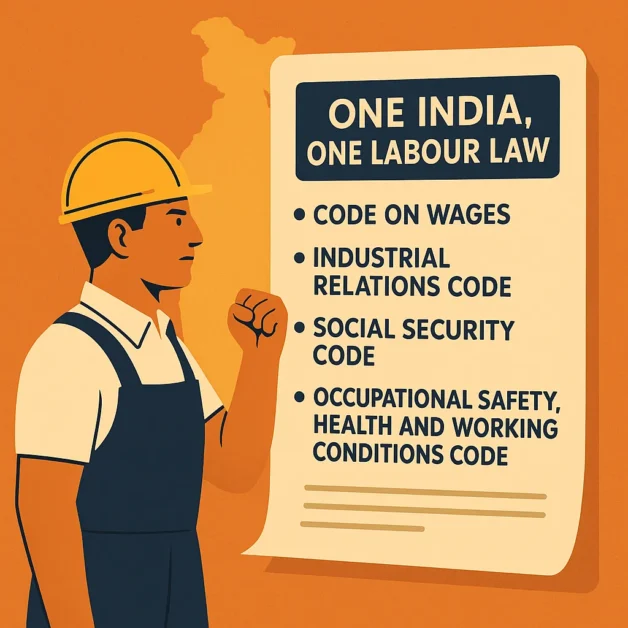
India’s four consolidated labour codes—the Code on Wages (2019), the Industrial Relations Code (2020), the Social Security Code (2020), and the Occupational Safety, Health and Working Conditions Code (2020)—were introduced as part of an ambitious effort to “modernize” and “simplify” India’s fragmented labour law regime.
These codes replaced 29 existing labour laws, promising efficiency, uniformity, and a “One India, One Labour Law” framework. However, a closer examination reveals that the new regime introduces structural weaknesses, expands employer discretion, and dilutes long-standing worker protections (Sharma, 2021).
This article unpacks ten major shortcomings of the new labour codes and evaluates how they depart from India’s long tradition of rights-centric labour governance.
1. The Raised Retrenchment Threshold: Job Security Now Depends on Worker Headcount
Under the old Industrial Disputes Act, 1947, establishments with 100 or more workers required prior government permission for layoffs, retrenchment, and closure.
The Industrial Relations Code, 2020 raises this threshold to 300 workers, enabling any establishment with 299 or fewer employees to terminate workers without government oversight (Bhowmik, 2022).
Why This Matters
- Easier firing and mass retrenchment
- Sudden job loss for MSME workers
- Incentive for companies to remain small or artificially fragmented
- Job security becomes arbitrary and numerical, not rights-based
Constitutionally, this weakens protection under Articles 14, 21, 38, 39A, and 43A, which mandate fairness, dignity, and worker participation (Basu, 2020).
2. Fixed-Term Employment (FTE): Hire-and-Fire Made Legal
The new codes legalize fixed-term employment across all sectors, enabling contracts of:
| Contract Type | Duration |
|---|---|
| Short-term | 3 months |
| Medium-term | 6 months |
| Extended-term | 1 year |
| Micro-contracts | Weekly contracts |
The Consequences
- Workers can be replaced frequently
- No guarantee of renewal
- Permanent work done through permanent temporaries
- Old jurisprudence deeming serial renewals “unfair labour practice” is diluted (Sen & Das, 2022)
India thus shifts toward hire-and-fire flexibility, weakening the principle of secure, long-term employment.
3. The 50% Allowance Cap: Reduced Take-Home Pay for Workers
The Wage Code defines wages strictly and mandates that allowances cannot exceed 50% of total remuneration.
On Paper
- PF and gratuity base becomes stronger
- Social security for formal workers increases over the long term
In Reality
- Workers immediately receive lower take-home pay
- Higher PF contributions offset disposable income
- MSMEs face compliance challenges (Venkatachalam, 2021)
4. Floor Wages Without a Living Wage Standard
The Central Government will set floor wages, but:
- No formula is prescribed
- No requirement for periodic revision
- No remedy if the floor wage is set too low
This violates India’s constitutional commitment to the living wage principle under Article 43 and ILO standards (ILO Global Wage Report, 2021).
5. Gig and Platform Workers: Recognition Without Rights
For the first time, gig workers (e.g., delivery riders, app-based drivers) are legally recognized.
But recognition does not translate into rights.
The Gaps
- Benefits depend on government schemes, not enforceable entitlements
- No mandatory social security
- Aggregator contributions are discretionary
- No right to collective bargaining or minimum wage (Kabra & Mehta, 2023)
Gig workers remain within a policy grace model, not a rights-based model.
6. Excessive Government Discretion Across All Codes
The codes give the government sweeping powers to:
- Exempt any establishment
- Change rules at will
- Relax compliance requirements
- Modify definitions and thresholds (Sankaran, 2020)
This results in state-to-state variation, undermining the promise of uniformity.
7. Complex Definitions: Increased Compliance Burdens for MSMEs
Though touted as “simplification,” the codes introduce:
- Rigid wage structures
- Complicated overtime rules
- Varying state-level rules
- Stricter requirements for standing orders
MSMEs face higher compliance costs, contradicting the objective of simplification (FICCI Labour Report, 2022).
8. Weakening of Trade Unions and Collective Bargaining
The Industrial Relations Code imposes:
- Mandatory notice periods for strikes
- Extension of strike restrictions beyond “public utility services” to all industries
- Stricter rules for union recognition
This undermines Article 19(1)(c)—the constitutional right to form associations (Krishnan, 2021).
Trade unions—once powerful instruments of industrial democracy—are reduced to procedural actors with limited real influence.
9. Penalisation of Workers: Punishment Without Protection
Workers may now face penalties for:
- Participating in “illegal” strikes
- Violating notice requirements
- Disorderly conduct
- Breaching prohibitions during conciliation
This is especially concerning because workers now enjoy less job security and fewer bargaining rights (Labour Law Review, 2021).
The economic burden shifts entirely onto employees.
10. OSH Code: Notification-Dependent, Slow, and Non-Uniform
The Occupational Safety & Health Code merges major safety laws but leaves implementation to state-level notifications.
Problems
- Slow rollout
- Varying state safety standards
- Limited inspections
- Offences made compoundable (i.e., negotiable) (Chakraborty, 2022)
Industrial safety becomes advisory rather than punitive, dangerous in a country with frequent industrial accidents.
Broader Structural Issue: Threshold-Based Protection
The common thread across all codes is that real protections exist primarily in establishments with 300+ workers.
But India’s labour force is overwhelmingly:
- Informal
- Casual
- Contract-based
- Small-establishment employed
Thus, the new codes give strong protections to a few, and weak protections to the majority (NITI Aayog Labour Analysis Report, 2021).
How the Labour Codes Could Be Improved
Experts suggest several reforms:
- ✔ Restore retrenchment threshold to 100 workers
- ✔ Restrict excessive use of fixed-term contracts
- ✔ Make gig worker social security mandatory and contribution-based
- ✔ Reduce rigidity in wage definitions
- ✔ Limit government discretion through clearer statutory provisions
- ✔ Strengthen trade union rights and allow emergency strikes
- ✔ Ensure uniform OSH standards nationwide
- ✔ Introduce whistleblower protections
- ✔ Improve severance (e.g., 45 days’ wages per year of service)
- ✔ Use AI-based safety audits for enforcement
These reforms would align India’s labour governance with constitutional commitments and international standards.
Conclusion
India’s new labour codes aim to modernize labour law, but they also shift the balance of power heavily toward employers, dilute long-standing protections, and risk widening the vulnerability of workers.
Without critical amendments, these laws may:
- Reduce job stability
- Promote fragmented employment
- Weaken unions
- Create uneven safety standards
- Leave gig workers unprotected
Reforms are both necessary and urgent to ensure that India’s labour governance remains fair, constitutional, and truly worker-centric.
References (Citations)
- Basu, D. (2020). Constitutional Law of India.
- Bhowmik, S. (2022). Industrial Relations in Contemporary India.
- Chakraborty, R. (2022). Occupational Safety Challenges in India.
- FICCI Labour Report. (2022). Impact of New Labour Codes on MSMEs.
- ILO Global Wage Report. (2021).
- Kabra, A., & Mehta, P. (2023). Platform Workers in India: Rights and Realities.
- Krishnan, S. (2021). Trade Unionism in Post-Reform India.
- Labour Law Review. (2021). Strikes and Penalisation Under New Codes.
- NITI Aayog Labour Analysis. (2021).
- Sankaran, K. (2020). Labour Codes and State Discretion.
- Sen, A., & Das, R. (2022). Employment Security and the FTE Model.
- Sharma, M. (2021). Simplification or Surrender? Understanding Labour Codes.
- Venkatachalam, V. (2021). Wage Structures Under the New Labour Code.