
The Indefinite Delay of Akhanda 2 and Its Legal–Financial Fallout
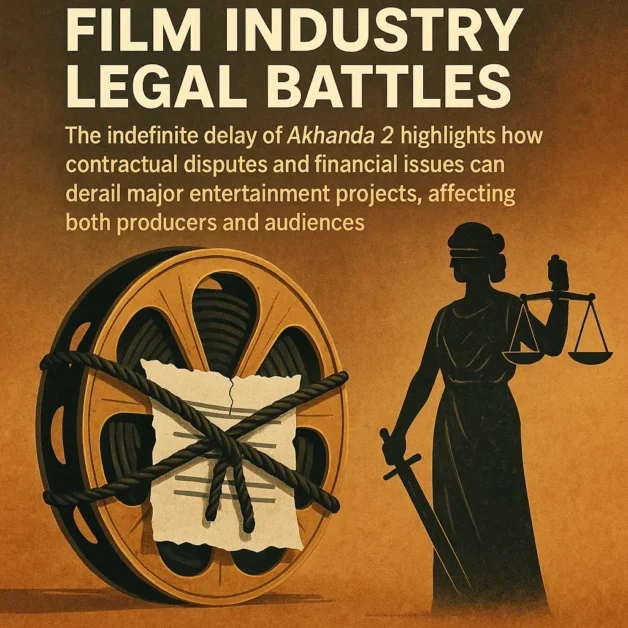
The indefinite delay of Akhanda 2 has once again exposed the fragile legal and financial foundations on which many big-budget Indian cinema projects rest. What was expected to be a high-voltage sequel to one of Telugu cinema’s biggest blockbusters has now become a textbook example of how film industry legal battles, contractual disputes, and financial instability can derail even the most promising entertainment ventures.
Beyond fan disappointment and box-office uncertainty, the situation highlights deeper structural problems in the movie business—where producer disputes, actor agreements, funding gaps, IP ownership, and distribution conflicts frequently collide, pushing major films into prolonged uncertainty.
Akhanda 2 Delay: What Went Wrong?
While official statements remain guarded, industry reports suggest that Akhanda 2 has been hit by a complex combination of:
- Contractual disputes between key stakeholders
- Financial restructuring issues
- Funding shortfalls and investor uncertainty
- Distribution and revenue-sharing conflicts
- OTT pre-sale delivery complications
The indefinite nature of the delay has escalated concerns because it triggers multiple legal consequences, ranging from breach of contract claims to recovery proceedings and injunction applications.
For fans, it means uncertainty. For producers, it means mounting liabilities. For financiers and distributors, it signals heightened commercial risk.
The Growing Problem of Film Industry Legal Battles
The Akhanda 2 dispute fits into a broader pattern of rising legal conflicts within the Indian entertainment industry, including:
- Producer vs actor salary disputes
- Director exit and replacement conflicts
- Music copyright and background score ownership issues
- OTT platform exclusivity breaches
- Distributor refund and recovery lawsuits
These film industry legal battles often result in:
- Court-issued injunctions halting releases
- Frozen production accounts
- Terminated distribution contracts
- Years of stalled litigation
How Contractual Disputes Cripple Big-Budget Films
Film production is governed by a web of contracts involving:
- Actors and talent agencies
- Directors and technical crew
- Producers and financiers
- Music labels
- Distributors and exhibitors
- OTT platforms
When just one major contract collapses—especially financing or distribution agreements—the entire project can grind to a halt.
Common Causes Include
- Non-payment of artist remuneration
- Breach of filming schedules
- Profit-sharing disagreements
- Failure to provide completion guarantees
- Termination of OTT delivery obligations
Financial Issues: The Silent Killer of Film Projects
Alongside legal breaches, financial mismanagement remains the biggest killer of large cinema projects. Rising costs of:
- Actor remuneration
- VFX and post-production
- Global marketing
- Overseas releases
- OTT and satellite packaging
have made film production heavily dependent on structured borrowing. When cash flow fails, even advanced-stage films face collapse.
In Akhanda 2, industry sources indicate unsettled production funding and delayed financial commitments as a key reason behind the indefinite suspension.
Impact on Producers, Actors, and Technicians
Producers
- Exposure to recovery suits
- Mounting interest liabilities
- Attachment of distribution rights
- Loss of business credibility
Actors
- Blocked professional schedules
- Loss of competing opportunities
- Contractual damage claims
- Legal notices for refund of advances
Technicians & Crew
- Pending wages
- Lack of job security
- No direct contractual remedies in many cases
How Film Delays Hurt Distributors, Theatre Owners & OTT Platforms
| Affected Party | Nature of Impact |
|---|---|
| Distributors | Unrecovered advances and blocked capital |
| Theatre Owners | Empty release calendars and revenue losses |
| Marketing Agencies | Loss of crores in sunk promotions |
| OTT Platforms | Deadline breaches and exclusivity failures |
Legal Dimensions of Film Industry Disputes: What the Law Says
The indefinite delay of Akhanda 2 raises multiple legal issues governed by Indian statutory law and judicial precedents.
1. Breach of Film Production Contracts
(Indian Contract Act, 1872 – Sections 10, 37 & 73)
When producers fail to honor payment schedules, production deadlines, or release commitments, it constitutes civil breach of contract, making them liable for monetary compensation.
- Case Law: Shree Hanuman Cotton Mills v. Tata Air Craft Ltd. (1969) – The Supreme Court confirmed that defaulting parties must compensate losses caused by breach.
2. Actor Contracts & Specific Performance
Actor agreements are personal service contracts, which courts do not enforce through forced performance, but compensation claims are fully maintainable.
- Case Law: Nandganj Sihori Sugar Co. v. Badri Nath Dixit (1991) – Personal service contracts cannot be specifically enforced, but damages apply.
3. Producer–Financier Disputes & Cheque Bounce Liability
(Negotiable Instruments Act, 1881 – Section 138)
If producers issue post-dated cheques as security and default, criminal prosecution under Section 138 applies.
- Case Law: ICDS Ltd. v. Beena Shabeer (2002) – Even security cheques attract Section 138 liability.
4. Injunctions Halting Film Release
Courts frequently restrain film releases where investor dues remain unpaid.
- Case Law: Yash Raj Films v. Sri Sai Ganesh Productions (2013) – Madras HC restrained release due to unsettled financier claims.
5. Intellectual Property & Sequel Rights
(Copyright Act, 1957)
Sequels raise serious issues relating to:
- Character ownership
- Story continuation rights
- Music reuse
- Title protection
- Case Law: R.G. Anand v. Deluxe Films (1978) – Copyright subsists in original expression, not ideas.
6. Arbitration & Alternative Dispute Resolution
(Arbitration & Conciliation Act, 1996 – Sections 9 & 17)
Most modern film contracts include arbitration clauses for faster dispute resolution.
- Case Law: Booz Allen & Hamilton v. SBI Home Finance (2011) – Commercial disputes, including film financing, are fully arbitrable.
7. OTT & Digital Distribution Breaches
Delivery delays violate OTT exclusivity contracts, attracting:
- Heavy penalty clauses
- Refund demands
- Blacklisting risks
- Case Law: Eros International v. Telemax Links (2016, Bombay HC) – Digital rights contracts strictly enforceable.
8. Criminal Liability in Financial Misconduct
(IPC Sections 406 & 420)
If dishonest intent exists from the start, criminal charges apply.
- Case Law: S.W. Palanitkar v. State of Bihar (2002) – Mere breach is civil, but cheating requires dishonest intent.
9. Consumer Protection Law & Audience Rights
(Consumer Protection Act, 2019)
Repeated misleading promotions and advance ticket sales can attract unfair trade practice claims, though courts prioritize contractual parties.
Case-Law Reference Table (Film & Entertainment Disputes)
| Legal Issue | Case Law | Legal Principle Established |
|---|---|---|
| Breach of Contract | Shree Hanuman Cotton Mills v. Tata Air Craft Ltd. (1969) | Defaulting party liable for damages |
| Actor Contracts | Nandganj Sihori Sugar Co. v. Badri Nath Dixit (1991) | No forced performance of personal service |
| Cheque Bounce | ICDS Ltd. v. Beena Shabeer (2002) | Security cheques attract Sec. 138 |
| Injunction on Release | Yash Raj Films v. Sri Sai Ganesh Productions (2013) | Release can be lawfully restrained |
| Copyright & Sequels | R.G. Anand v. Deluxe Films (1978) | Copyright protects expression |
| Arbitration | Booz Allen v. SBI Home Finance (2011) | Commercial disputes are arbitrable |
| OTT Contracts | Eros International v. Telemax Links (2016) | Digital distribution enforceable |
| Criminal Breach | S.W. Palanitkar v. State of Bihar (2002) | Cheating requires initial dishonest intent |
Legal Analysis Box (For Advocates & Law Students)
Core Legal Issues Triggered by the Akhanda 2 Delay
- Breach of multi-party production contracts
- Financing defaults & recovery litigation
- Section 138 NI Act cheque bounce exposure
- Section 9 Arbitration Act interim injunction risk
- Copyright continuity disputes in sequels
- OTT platform delivery breach
- Criminal breach of trust potential
Likely Legal Proceedings Path
- Arbitration invocation
- Interim injunction under Section 9
- Civil recovery suits
- Cheque bounce prosecution
- Criminal FIR (if fraud is established)
Legal Risk Profile of Delayed Film Projects
- High civil exposure
- Medium criminal exposure
- Severe commercial blacklisting risk
Legal Conclusion: Why Akhanda 2 Is a Classic Film Law Failure
The indefinite delay of Akhanda 2 reflects a multi-layered legal collapse involving contract breaches, financing defaults, IP complexities, distribution violations, and OTT delivery failures. Indian courts have consistently held that entertainment is a business governed strictly by commercial and IP law—not just creative freedom.
Final Takeaway
From stalled blockbusters to courtroom battles, the Akhanda 2 episode is a powerful reminder that:
- Strong contracts
- Strict financial discipline
- Well-drafted arbitration clauses
- Clear IP ownership
- Transparent revenue-sharing
are the only safeguards against film industry legal disasters.
Until such systems become standard practice, major entertainment projects will continue to face derailment through legal and financial chaos—leaving producers burdened, artists stranded, distributors exposed, and audiences disappointed.