
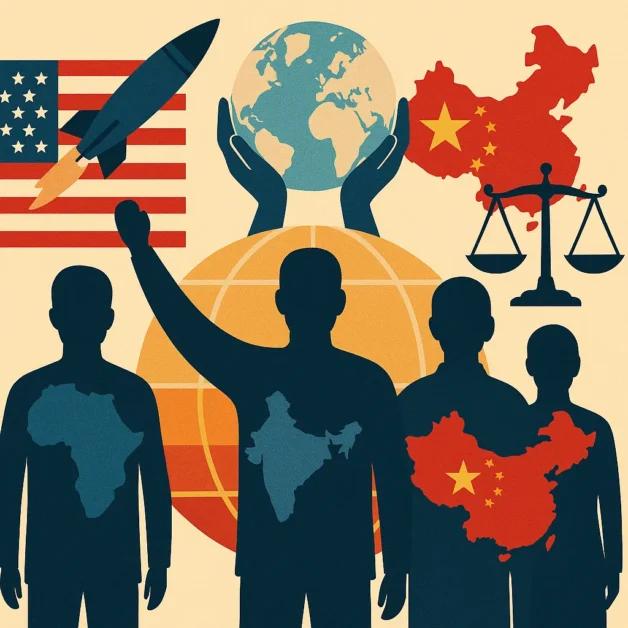
The Mirage of Absolute Power After the Soviet Collapse
When the Soviet Union disintegrated in 1991, it marked not only the end of a superpower but also the beginning of a dangerous illusion. The United States, suddenly standing alone as the world’s dominant force, believed it had reached the “end of history.” Washington genuinely convinced itself that no rival could ever rise again. Russia was dismissed as a defeated shadow. China was seen merely as an agrarian backwater.
This moment of triumphalism shaped global policy for decades. The idea that the world would remain permanently unipolar proved deeply flawed. Economics, as Adam Smith once explained, does not work on arrogance or entitlement—it works on open trade, knowledge transfer, peace, and smart policy. While American policymakers looked away, China quietly executed the most rapid economic transformation in human history, sustaining nearly 10% growth for decades and lifting hundreds of millions out of poverty.
Today, in 2025, the results are clear: the global balance of power has fundamentally shifted. China is now a technological, manufacturing, and financial heavyweight. India is emerging as the next growth engine. The idea of permanent American dominance now appears as one of the greatest strategic miscalculations of modern times.
NATO Expansion and the Road to the Ukraine War
One of the most serious consequences of post–Cold War overconfidence lies in Eastern Europe. During German reunification in 1990, the United States made explicit assurances to Soviet leader Mikhail Gorbachev that NATO would not expand “one inch eastward.” Historical archives today confirm these commitments beyond doubt.
Yet once the Soviet Union collapsed, those promises were quietly abandoned. NATO expanded relentlessly toward Russia’s borders. This steady encirclement created deep strategic anxiety in Moscow. The war in Ukraine did not erupt in a vacuum—it was the tragic outcome of decades of broken assurances, escalating military footprints, and zero-sum geopolitics.
As of 2025, millions of Ukrainians are either displaced, wounded, or dead. Cities lie in ruins. A whole generation has been sacrificed in a war that might have been avoided through diplomacy rather than military expansion. The bitter irony is that Ukraine aligned itself with Western power for protection—only to become the primary battlefield of great-power rivalry.
| Key Factor | Impact |
|---|---|
| NATO Eastward Expansion | Heightened Russian security anxiety |
| Broken Assurances (1990) | Loss of diplomatic trust |
| Ukraine War (2022–2025) | Mass displacement, destruction, and casualties |
Gaza, International Law, and the Crisis of Western Moral Authority
While Ukraine burns in Europe, Gaza bleeds in the Middle East. Western powers that once positioned themselves as the guardians of international law now face rising accusations of double standards. South Africa’s bold decision to approach the International Court of Justice (ICJ) accusing Israel of violating the Genocide Convention marked a historic turning point.
In 2024 and 2025, global public opinion has visibly shifted. Massive protests across Europe, the U.S., Asia, and Africa reflect growing outrage over civilian suffering and selective application of human rights principles. Although the ICJ moves slowly, the moral weight of the case has reshaped international discourse.
For many nations in the Global South, this moment confirms what they long suspected: international law often bends under the weight of geopolitical interests.
The Return of History and the End of the Unipolar World
We are now living through a global rebalancing of power. BRICS has expanded. The Gulf states are hedging their alliances. Africa is demanding a greater voice. Latin America is recalibrating ties. Even traditional U.S. allies are diversifying partnerships.
The unipolar moment is over. A multipolar world—messy, competitive, but more representative—is taking shape.
Yet power alone is not the real story.
The True Crime of Imperialism: The Theft of Knowledge
Beyond military conquest and economic extraction, the deepest wound left by imperialism was the deliberate denial of education. Knowledge is the greatest source of power any society can possess. To keep populations uneducated was to keep them permanently dependent.
When African nations gained independence, UNESCO studies showed that many countries inherited illiteracy rates exceeding 90%. Colonization did not build thinkers, engineers, scientists, or researchers—it built extractive economies designed to serve distant empires.
This catastrophic knowledge gap still shapes today’s inequalities.
Africa’s Defining Opportunity: Unity and Learning at Continental Scale
Africa today stands at a historic crossroads. With a population of nearly 1.5 billion—equal to India and larger than China—the continent possesses demographic power no civilization in history has ever commanded. Yet fragmentation into more than 50 nations weakens bargaining power, economic scale, and global influence.
This is why institutions like the African Continental Free Trade Area (AfCFTA) are pivotal. For the first time, Africa is attempting to operate as a single economic space. If successful, it could unlock scale-driven growth similar to China’s transformation and India’s ongoing rise.
But markets alone are not enough.
The Real Revolution Must Be a Learning Revolution
Universities, digital education platforms, research institutions, and skill ecosystems must become Africa’s greatest investment priority for the next 20 years. A continent that learns fastest will grow fastest. A continent that produces knowledge will shape the future rather than consume it.
India, China, and the Road Africa Can Follow
China defeated mass poverty in just 40 years through national planning, industrial policy, and scale. India is now walking a similar path, powered by digital public infrastructure, manufacturing reforms, and financial inclusion.
Africa, with equal population strength, stands next in line—if it unites, educates, and invests wisely.
The 21st century may yet become Africa’s century, just as the 20th was America’s and the early 21st has been Asia’s.
A World in Transition: What the Next Decade Demands
The age of domination is ending. The age of shared power, shared knowledge, and shared responsibility is beginning—whether the old powers accept it easily or not.
Three Forces Will Decide the Next Era
- Knowledge as Power: Education, AI, digital governance, and science will define national strength.
- Unity Over Fragmentation: From Africa to the Global South, scale is survival.
- Moral Consistency in Global Law: Selective justice is collapsing under public scrutiny.
Conclusion: Reclaiming a Future That Was Delayed
We are not merely entering a new world order—we are attempting to reclaim a future that should have existed long ago. One built on open exchange instead of conquest, on education instead of domination, on cooperation instead of coercion.
Empires once ruled by controlling land and labor. The future will belong to those who liberate minds.
And in that future, Africa, Asia, and the long-silenced Global South are no longer waiting for permission to rise.
They are already rising.